healthcare · 2021–2023
Real-time arterial blood-flow prediction
A machine learning model that predicts patient-specific arterial blood flow in seconds instead of hours, so it can be used during a consultation rather than overnight.

Problem
Predicting how blood flows through a specific patient’s artery is central to diagnosing vascular disease and planning treatment. The physics is well understood, but the simulations that capture it are slow — a high-fidelity 3D flow solve can take hours, especially around the tricky regions like bifurcations where disease tends to develop. Hours is fine for research. It is useless in a consultation room, where a decision has to be made while the patient is still sitting there.
That gap is what keeps this kind of simulation out of everyday clinical use. The question I set out to answer during my PhD was whether a model could give the same answer fast enough to be used in real time, without throwing away the fidelity that makes it worth having.
Approach
I built a reduced-order model — a surrogate that learns the behaviour of the full simulation and reproduces it at a fraction of the cost. The framework, FastSVD-ML-ROM, combines classical dimensionality reduction with machine learning in stages:
- an SVD update that builds a linear subspace of the solution as the simulation proceeds, rather than all at once up front;
- a convolutional autoencoder for the nonlinear compression the linear step can’t capture;
- a feed-forward network mapping input parameters into that latent space;
- an LSTM to predict how the flow evolves in time.
The point of stacking them was to keep the parts of the flow that a purely linear method loses — which, for arterial flow, are exactly the parts that matter. The work was published in Computer Methods in Applied Mechanics and Engineering (Drakoulas et al., 2023).
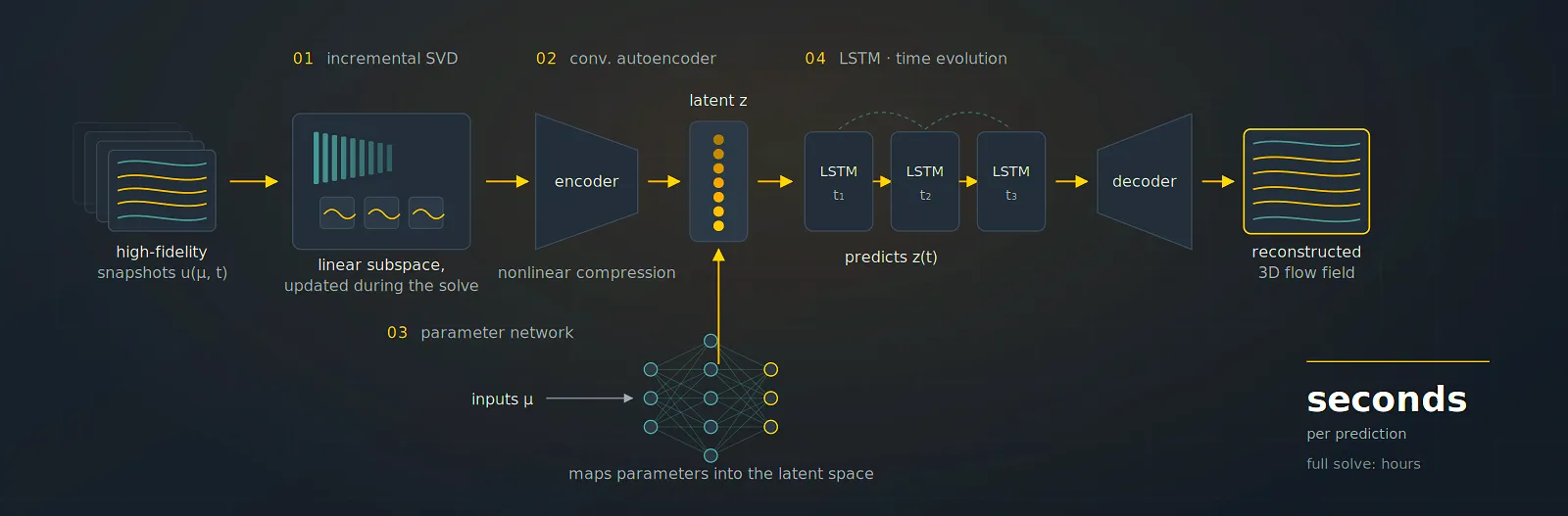
The pipeline: incremental SVD and a convolutional autoencoder compress the flow, a parameter network and an LSTM predict how it evolves, and the decoder reconstructs the full 3D field — in seconds per prediction against hours for the full solve.
Result
The model reconstructs 3D arterial blood flow, including at bifurcations, in seconds instead of hours — fast enough to sit inside a real-time, patient-specific digital twin rather than an offline study. The reconstruction stayed accurate enough across the test cases to trust the approach, which is the bar a surrogate has to clear before anyone will use it in place of the real solve.
What I’d do differently
The heaviest cost was data: the model trains on parameterised simulation snapshots that themselves take real time to generate, and the pipeline for producing and curating them was more work than the network. If I built it again I’d design that data-generation pipeline first, and I’d invest earlier in quantifying uncertainty — a clinician needs to know not just the prediction but how much to trust it, and that belongs in the model from the start, not bolted on after.