Nobody puts a thermometer on every tube. A physics model fills in what the
sensors can't reach: hot water giving up its heat along the tubes, cooling
water weaving around the baffles, and the thin layer at each tube wall
where most of the resistance to heat flow lives.
Three instruments, every two seconds
The twin stays connected to reality.
Inlet and outlet temperature and cooling-water flow, read from the real
pipework, feed the model continuously. From them it re-estimates how well
the exchanger is transferring heat, so the physics follows the machine as
it ages instead of drifting away from it.
Machine learning · trained on the plant's own history
An AI model learns what the equations leave out.
Equations know how heat moves through a tube. They don't know that this
exchanger fouls faster in summer, that one sensor reads a little high, or
how the plant upstream behaves on a Monday. A machine-learning model trained on months of
the plant's own data learns those things, and hands the physics better
inputs than a fixed guess would.
Solid is now · ghosted is +30 min
Physics explains the system. AI predicts what happens next.
The AI model forecasts what the plant will send in; the physics turns
that into what the machine will do. In this demo the forecast is
deliberately simple — a trend on the inlet temperature. Because its output
goes through the physics, it can't predict a machine that breaks the energy
balance.
Back on the real machine
Predictions become decisions.
The forecast is only useful once someone can act on it: the outlet will
cross its limit within the half hour, this much cooling flow holds it, and
this is how long until the tube bundle needs cleaning.
Demonstration asset with synthetic operating data. Physics: ε-NTU model of
a one-shell, two-tube-pass exchanger, its conductance re-estimated from the
measurements. The fields are simplified from that model, not CFD.
Why AI in engineering
Physics is accurate. It is also slow and expensive.
One high-fidelity simulation of flow, heat or structure can take hours to
days on a cluster, and a real design needs hundreds of them. So most teams
check a handful of options and hope. AI models trained on the physics
change the arithmetic: they learn from simulations and measurements, then
design, simulate and predict in minutes instead of days, with the physics
still the judge.
Hours versus seconds
Where the time goes
A full simulation solves the equations from scratch for every design you
ask about. An AI model trained on those simulations has already learned how
the answer changes with the design, so asking it again costs almost nothing.
The clock below is logarithmic: each step is roughly sixty times the last.
1 s1 min1 h1 day1 week
Full simulationhours to days
AI modelseconds to minutes
Time for one design evaluation · logarithmic clock
In one working day
~4designs checked by full simulation (one dot = 1)
~5,000designs checked by an AI model (one dot = 100)
Illustrative ranges, not a benchmark: it depends on the physics, the mesh and the hardware.
One part, end to end
Draw it, prove it, watch it work
To make it concrete, follow one steel bracket through the three steps an
engineering team goes through: design it, check it holds, and keep an eye
on it in service. The stress analysis is real, solved for this page, and the
same numbers carry through all three steps. With a fast model, thousands of
variants like it can be checked instead of five. And once it is installed,
the model keeps working: it turns one strain gauge into the stress where no
gauge can go.
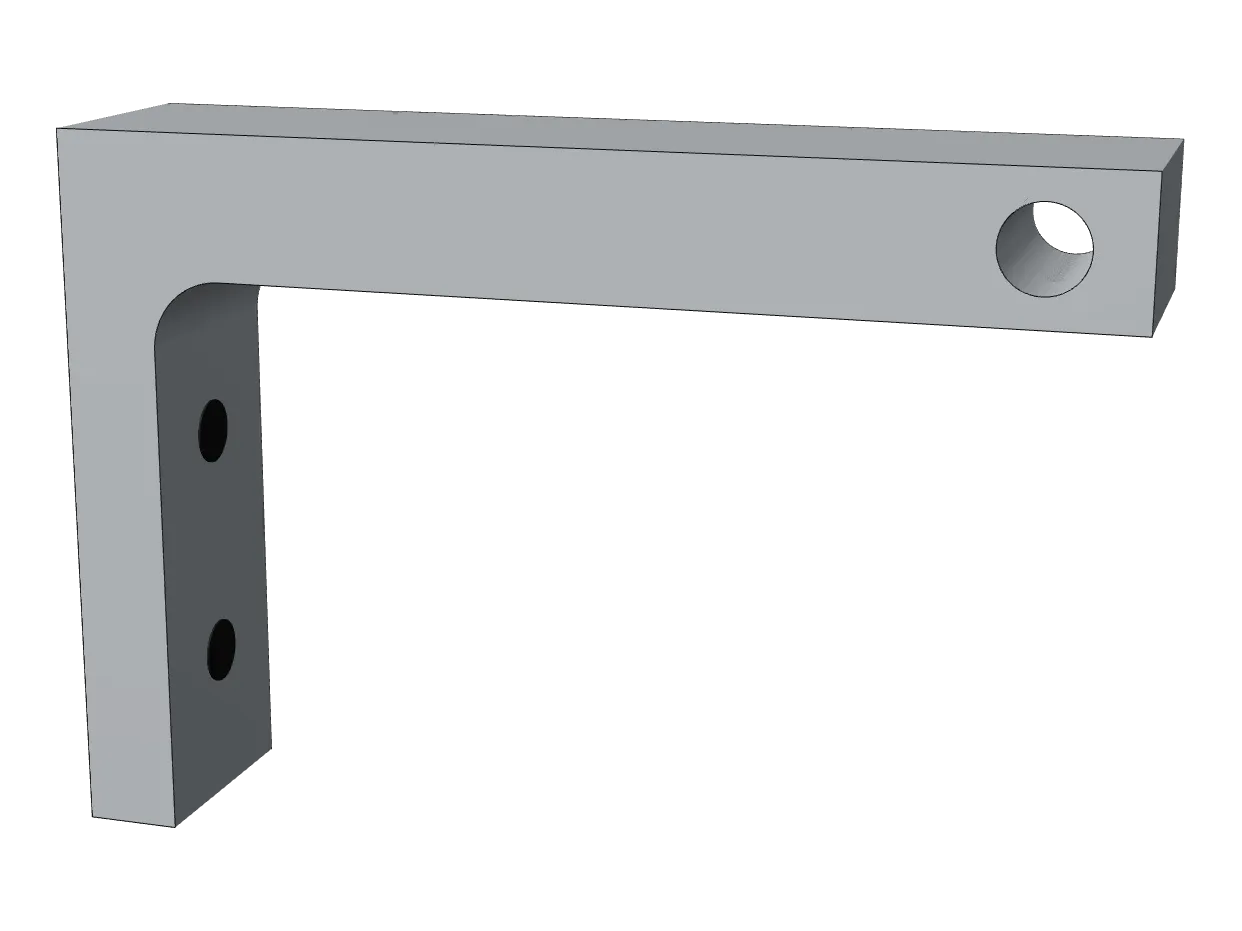
01 Design
Drawing and 3D model: 176 × 120 mm, a 12 mm fillet where the arm
meets the flange, a 14 mm pin hole for the load.
0von Mises, MPa150
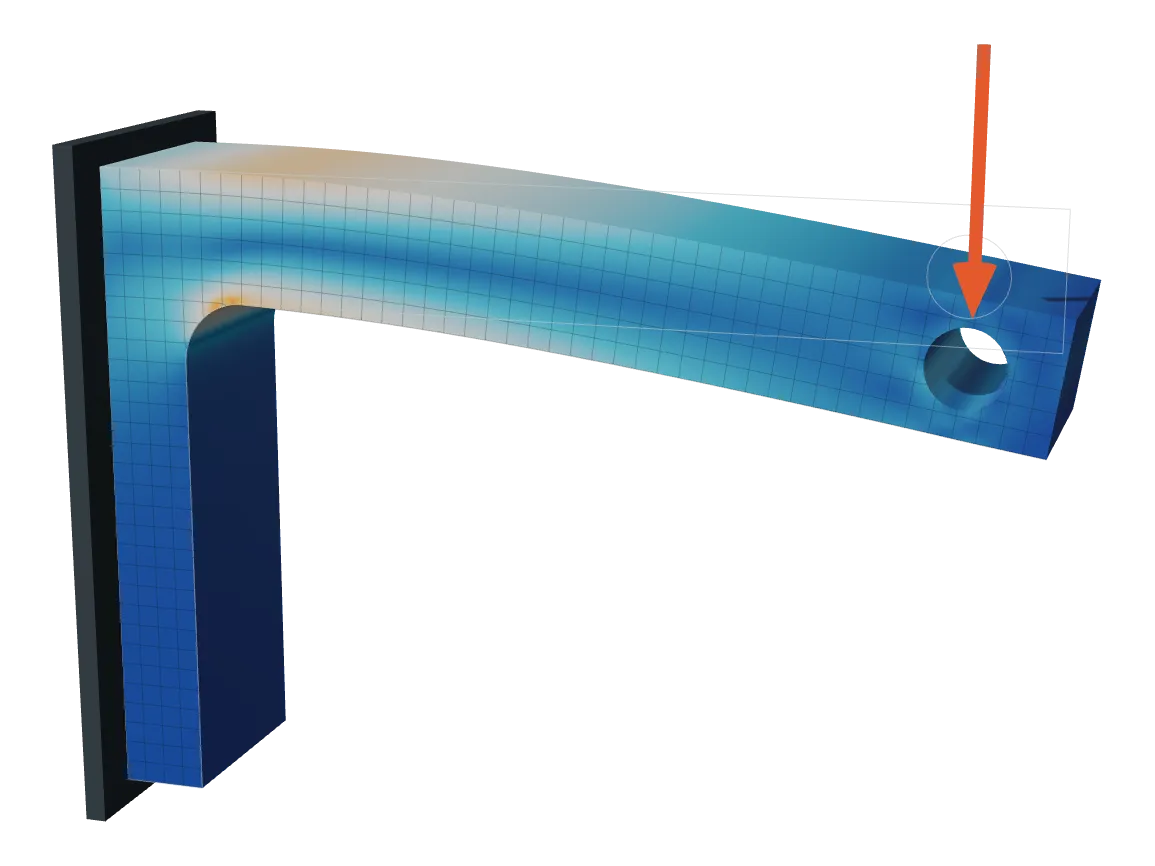
02 Simulate
Finite-element solve: 5,636 elements, 3 kN on
the pin. Stress peaks at the fillet, 138 MPa,
2.6× below yield. Bend drawn ×45.
SG-01 · strain408 µεAI · fillet stress138 MPa
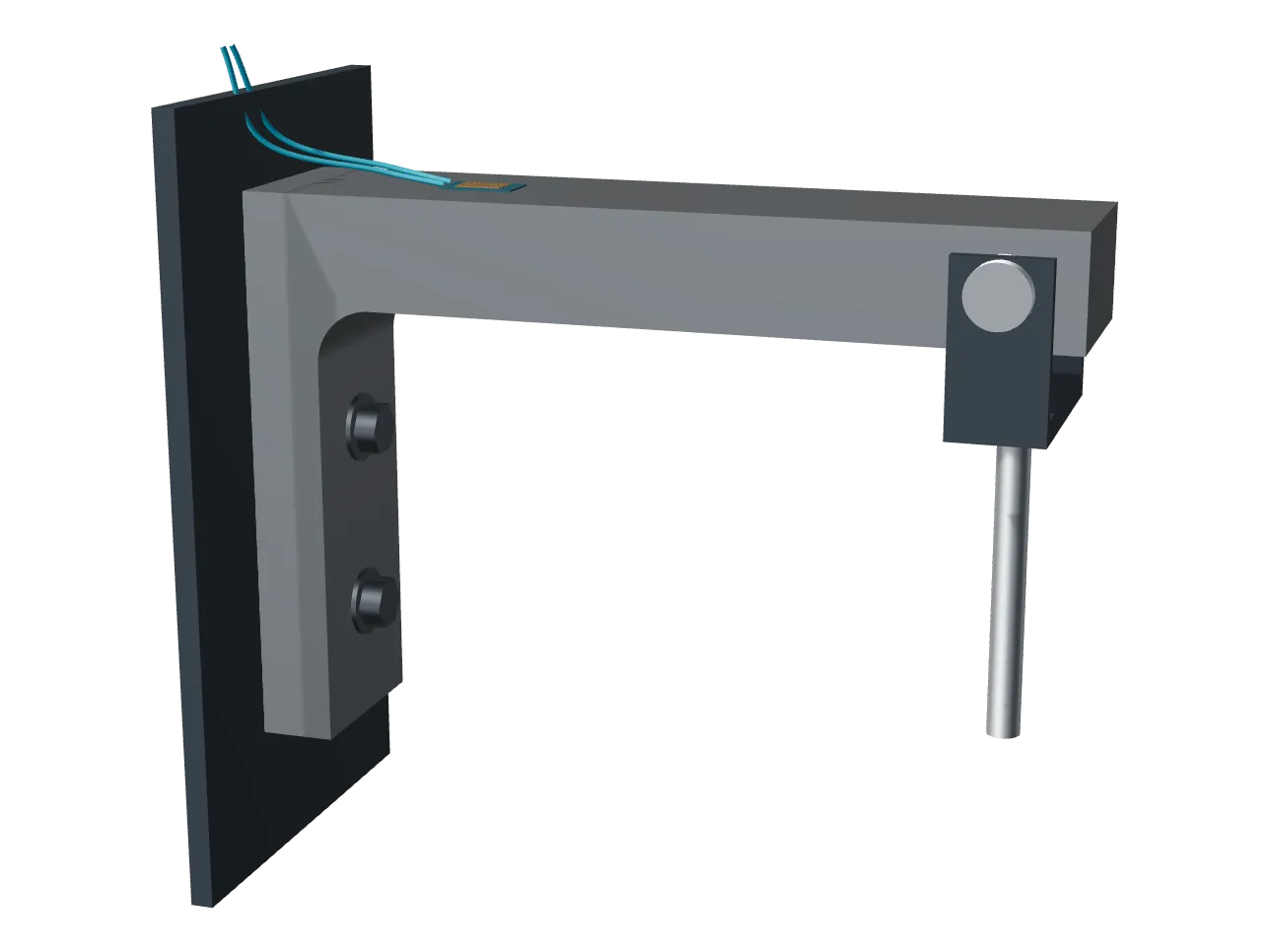
03 Predict
A strain gauge on the top face; the AI model, trained on the simulations, infers
the fillet stress from it, live.
The same idea, other assets
The bracket is simple on purpose. The same loop, a physics model, data from
sensors and an AI model trained on both, works on far more complex assets:
rotating machinery, ship hydrodynamics, aircraft structures. Every asset hides
the part you most need to know. Each image below is cut the same way: the
left half is what a twin computes, the right half is what you can see.
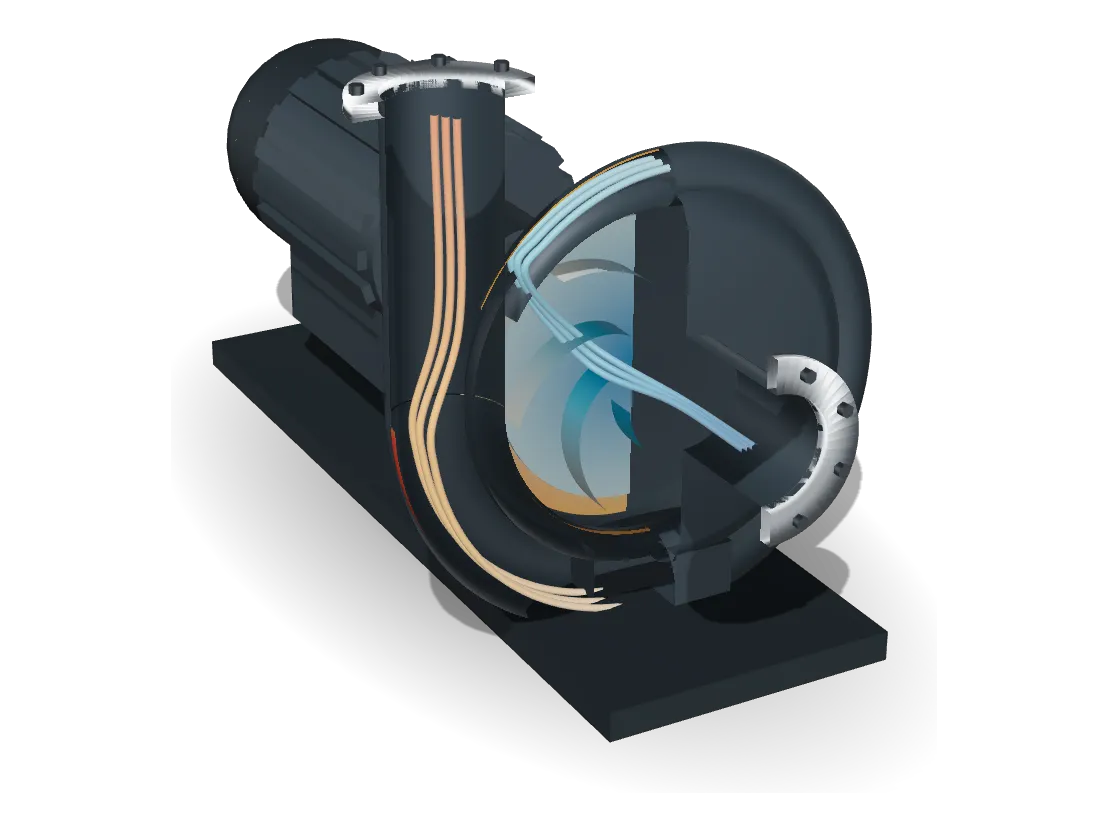
Centrifugal pump
Predictive maintenance
Turn vibration, pressure and power readings into early warning of wear
and cavitation, before an inspection round would have caught it.
Ship propeller
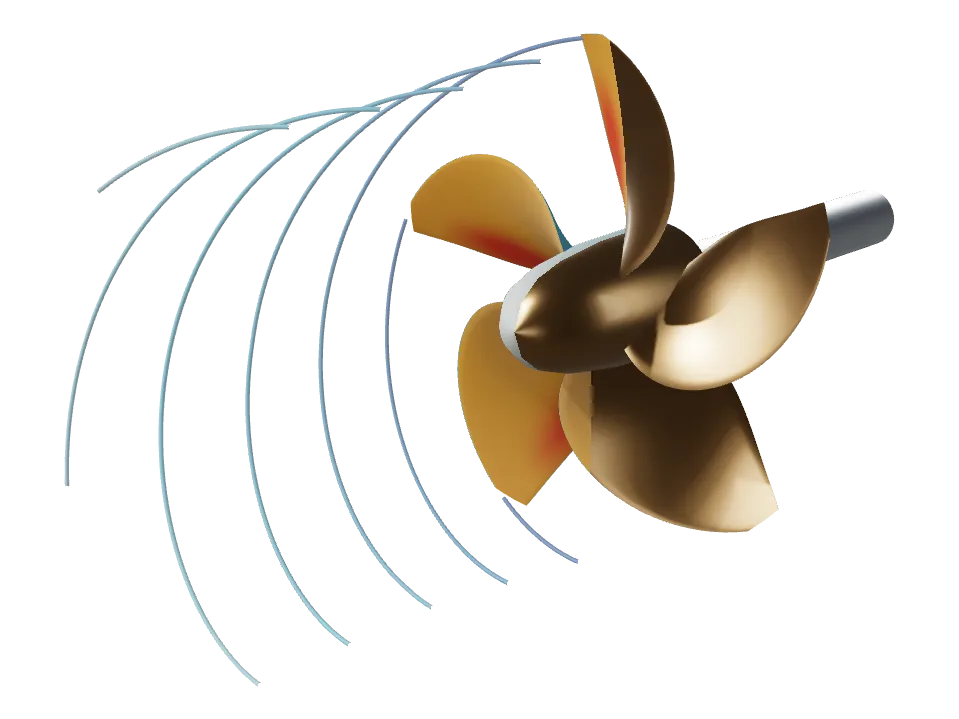
Surrogate models
Replace hour-long hydrodynamic simulations with models that answer in
seconds, so a design team can explore instead of only validating.
Aircraft wing
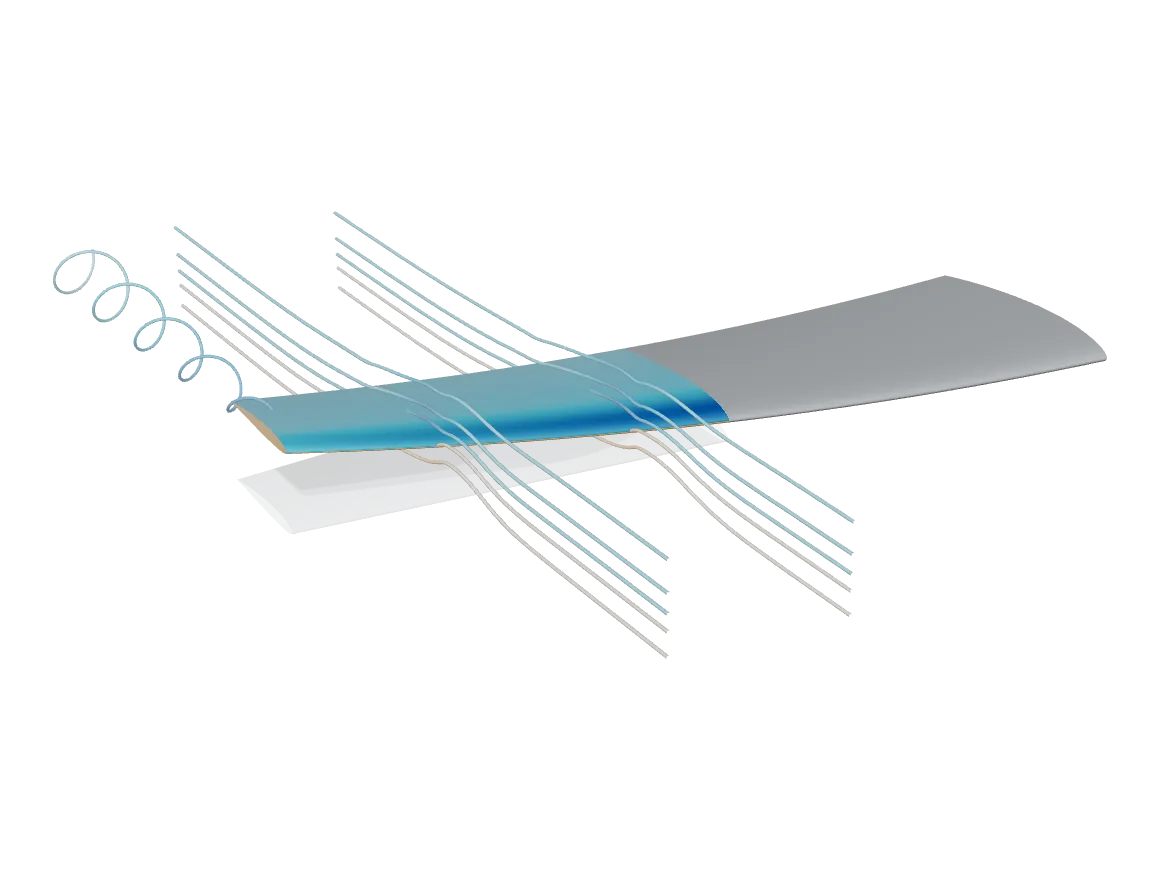
Fluid–structure interaction
Air loads the wing, the wing bends, and the bend changes the air. AI
models learn that two-way coupling, so a design can be checked in
minutes instead of days of coupled simulation.
I built a local pipeline that reads part drawings, rebuilds them in 3D and prepares laser-cutting quotes. What works, and why fine-tuning on your own drawings pays off.
Construction drawings are precise and hard to read at a glance. Here's what it takes to turn a set of them into an interactive 3D warehouse you can rotate, cut away and inspect.
A simulation that takes days, and a decision that can't wait?
That is the problem I like: a physical system, an expensive model, and a
question that needs an answer in minutes. Whether it's a design to explore
or an asset to predict, glad to compare notes.